
Getting Houston County Court Records
Begin with the court that made the record. The Houston County District Clerk holds district proceedings, felony files, and district civil and family records. The County Clerk keeps constitutional County Court matters and the County Court at Law records assigned there. Justice and municipal courts hold their own lower-court material. For a Houston County docket search, that first question of court and clerk saves time. Both county offices link to the Online Records Search, known as LGS. Guest mode shows index information. Registered users can preview or buy eligible images. The official FAQ points people to the county office when detail is not public in the portal. In-person, written, telephone, and clerk-assisted requests still work well.
- Identify the court and clerk from the caption or cause number.
- Search the local LGS index in the relevant office and record type.
- Check a published docket PDF if the need is a hearing setting.
- Ask the custodian for a named document, image, or certified copy.
- Save the search date, source, receipt, and version received.
Houston County's Three Record Layers
A hit in the portal does not mean the full Houston County court record is online. Local access really comes in three layers. The index layer just identifies a case. A court docket or calendar lists activity and settings. The document layer holds pleadings, orders, and other filed images, but only when they are public and available.
- Index
- A searchable pointer with basic case data, not the entire file.
- Docket or calendar
- A list of events or future settings that may not state the final outcome.
- Document or file
- The filed material, subject to access limits and redaction.
- Certified copy
- A copy authenticated by the clerk, not just a downloaded portal image.
A public calendar PDF can be accurate yet thin. It may skip motions, exhibits, orders, and later changes. A purchased portal image is not certified unless the clerk completes certification, so match the product to the need before paying.
Houston County Court Record Types
Houston County court records span docket sheets, petitions, complaints, motions, orders, judgments, notices, writs, abstracts, and hearing calendars. District files cover felonies, civil suits, and family matters. County Court at Law files can include misdemeanor, civil, probate, guardianship, mental-health, and juvenile cases within its stated jurisdiction.
| Record | What It Shows | Source |
|---|---|---|
| Index entry | Cause, party, type, or filing reference | LGS or clerk |
| Future-settings docket | Date, time, court, event, and status | Court page |
| Filed document | Pleading, notice, motion, or order | Portal or clerk |
| Certified copy | Clerk-authenticated reproduction | Custodian clerk |
Municipal records run through city routes. Crockett accepts written public-information requests for city material, and Kennard publishes an open-records path. Do not assume a city citation file sits in the county LGS portal.
Houston County Record Request Fields
The County Clerk Public Information Act form asks for requester and contact details. It also asks for a description, a date range, and delivery or redaction preferences. Nothing on its printed fields fixes one universal email, payment method, or court-copy fee. Be specific when you submit it. Name the court and cause if known. Describe the exact docket, order, filing, or date span. State whether you want inspection, an electronic image, a paper copy, or certification. Then ask whether the item is public, restricted, redacted, or unavailable in that form.
Useful request: Give the court, cause number, document title, filing date or range, preferred format, and certification need.
Inside a Houston County Court Record
A Houston County court record can show the court, cause number, case type, filing date, parties, attorneys, event history, settings, and disposition. Documents add titles, dates, signatures, and clerk stamps. The docket itself is a register of activity. It is not a transcript of every word spoken.
| Cause number | The identifier joining the index, docket, and documents. |
|---|---|
| File date | When material entered the clerk's record. |
| Event or setting | A procedural step, not always a trial. |
| Disposition | The recorded outcome when entered. |
| Image status | Whether an eligible item may be viewed or bought online. |
Some public entries show no viewable detail. The LGS FAQ sends users to the county office in that situation. Rely on field labels and redacted examples, never private identifiers.
Two Houston County Record Counters
You can reach both record counters in Crockett. The District Clerk sits at 401 East Houston Avenue, First Floor, Crockett, Texas 75835. It lists (936) 544-3255 extension 235. The County Clerk shares the street address in Suite 103, with extension 241 or 242. Its public hours are 8:15 a.m. to 4:15 p.m., Monday through Friday, excluding holidays.
Houston County District Clerk
401 East Houston Avenue, First Floor
Crockett, TX 75835
(936) 544-3255 ext. 235
Houston County County Clerk
401 East Houston Avenue, Suite 103
Crockett, TX 75835
(936) 544-3255 ext. 241 or 242
Call first if the file type is unclear. A County Court at Law matter may be assigned by category, so the court name alone may not settle which clerk has custody.
Fees and Certified Copies
The District Clerk's schedule effective January 1, 2024 lists copies at $1 per page, certification at $5 plus copies, a $5 search per name, an $8 abstract, and an $8 writ.
| Item | Published Fee |
|---|---|
| Copy | $1 per page |
| Certification | $5 plus copies |
| Search | $5 per name |
| Abstract | $8 |
| Writ | $8 |
LGS adds a mandatory $0.30 transaction fee at checkout. Its FAQ also describes monthly and annual subscriptions, up to five image purchases before a subscription is required, and receipts under Subscriptions/View Receipts. Confirm current totals before you rely on them. The schedule carries a date, and page count affects the final cost.
Houston County Record Preview vs Certification
A preview in the LGS system is a quick check that you have the right filing. Buying the image gets you the electronic copy itself. Neither step adds clerk certification. That is a separate service. The District Clerk charges for it as its own add-on.
The official portal FAQ walks through each layer. It covers registering as a user, searching as a guest, buying images, subscribing, and handling receipts. Once you complete a purchase, save the receipt, the source URL, the version, and the date you searched. If you plan to file or formally present the record somewhere, ask that office first what form it will accept.
There is also a broader line to know. The state judiciary's official records-policy page shows where administrative open-records requests end and case-record access begins.
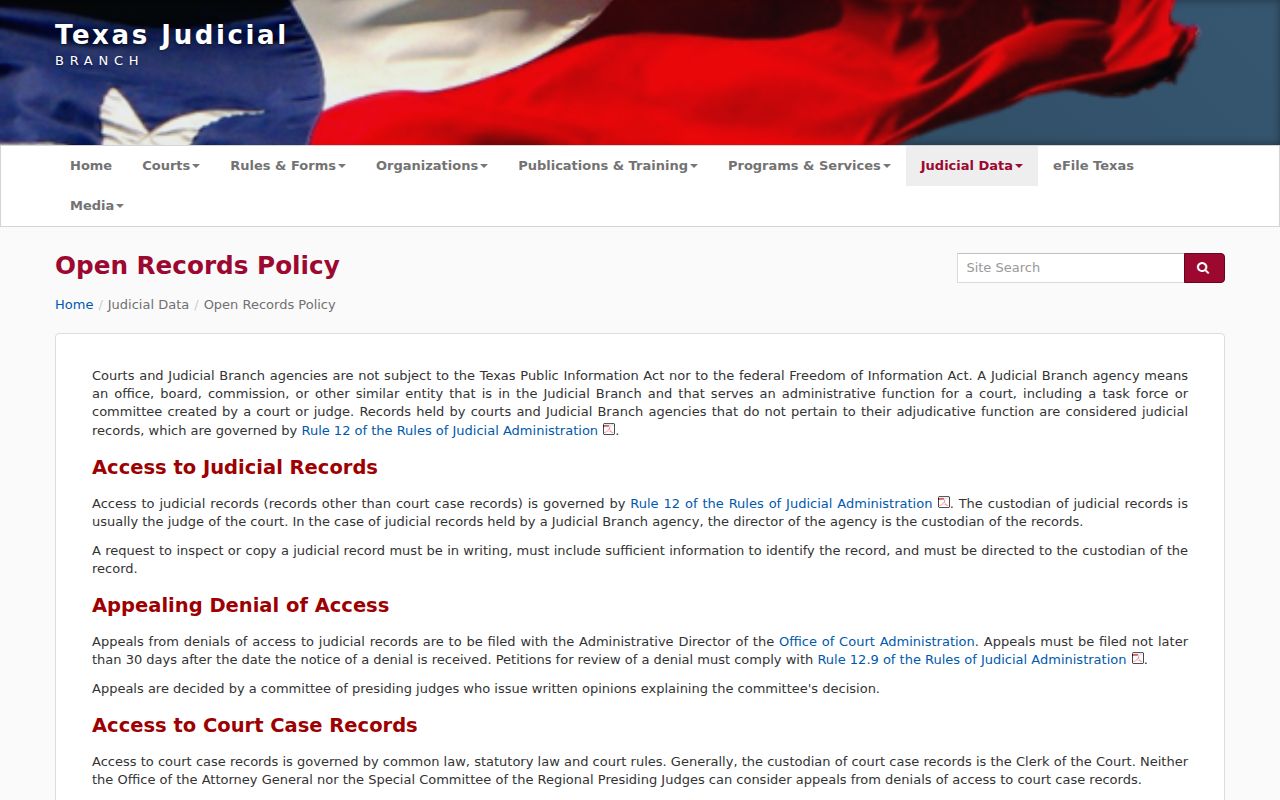
That line matters locally. For a Houston County case document, the District Clerk or County Clerk, not a statewide administrative-record officer, is normally the starting point. Remember: a clear portal image may still be uncertified.
Sealed Records and Public Access
Texas splits its rules in two. The Texas Courts Open Records Policy draws a line between case records and judicial administrative records. Each side follows its own law. Case papers filed in a Houston County court docket are public record material under Government Code Chapter 552. That is the Texas Public Information Act. That act carves out the judiciary in section 552.0035, though. Judicial Administration Rule 12 sits on the administrative side instead. It governs records about how the courts run rather than every filing in a case.
Not everything in a court file is open. Sealed, confidential, expunged, restricted, or redacted material may never reach a public docket search. Expunction and nondisclosure are two different remedies with separate rules. For the first, the District Clerk posts expunction information worth reading before you file anything. The statute behind it is Code of Criminal Procedure Chapter 55A.
Access rule: A missing image does not prove no record exists. Ask whether it is restricted, redacted, sealed, or available another way.
When Houston County Records Are Hidden
Say a docket entry shows up. The detail or image behind it will not load. Write down the cause number, the court, the label, and the date you searched. Then call the clerk. Ask directly whether the item is public. Ask whether you can inspect it, get a redacted copy, or have it certified.
Know what kind of block you are dealing with, because the fix differs. A restriction sometimes covers only part of a file. Redaction strips protected content and releases the rest. Sealing instead shuts access under a court order or a rule of court. Expunction is its own statutory process. Trust the status the clerk reports, not a blank screen that might mean nothing at all.
Try more than one channel, but treat none as a stand-in for the others. Compare the LGS index against the court's dated docket archive. Ask whether the cause number was filed under a different record type. Need only a hearing date? Use the published calendar and confirm later changes with the court. Need a filed order? Name that order rather than asking for the whole case file.
How you take delivery matters too. Inspection alone can settle a narrow question without copies. An electronic image is often fastest when the clerk offers one. Paper costs climb on a big file. Certification is a separate clerk act with its own charge. Ask for an estimate and a page count before you pay. Keep the request tied to the fee schedule.